
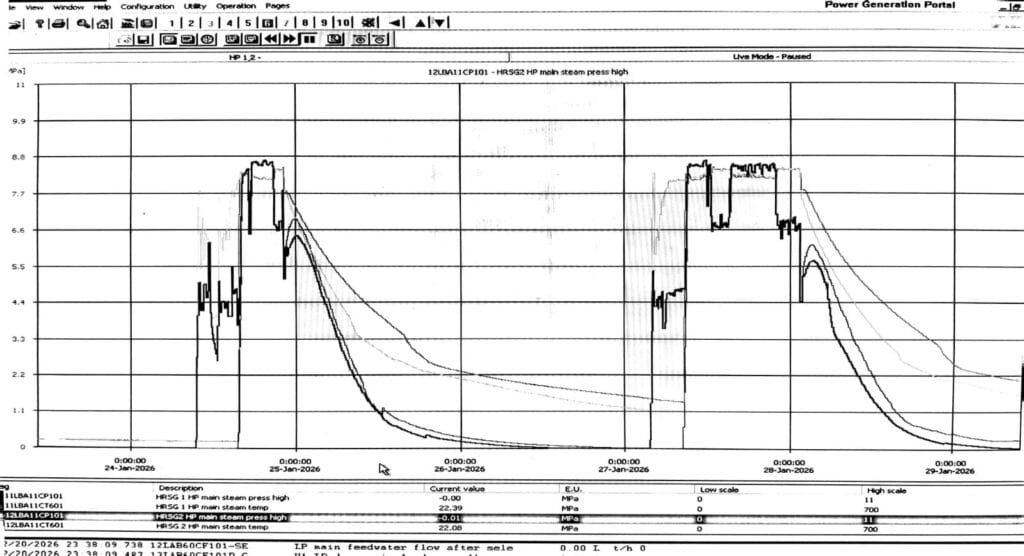
Steam turbine startup is normally discussed in terms of pressure and temperature targets, but in practice the constraint is rarely the value itself. The constraint is how those values move relative to each other and to the metal.
The Logarithmic Trap
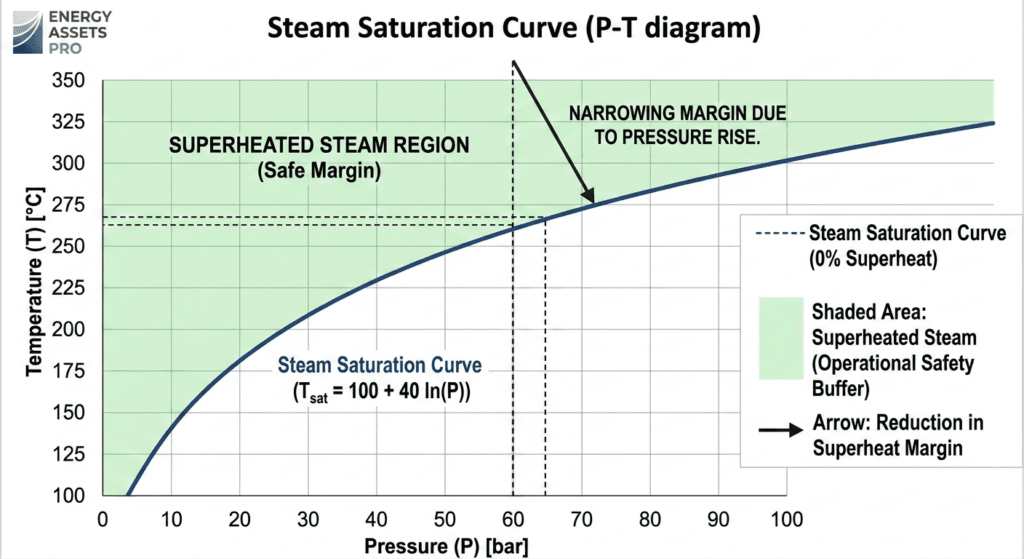
Saturation temperature (Tsat) does not rise linearly. It shifts with pressure in a logarithmic manner. When you close the bypass to build pressure, Tsat jumps immediately. If your heat input (GT load) doesn’t respond at the same pace, your effective superheat margin narrows, even if the DCS shows a steady steam temperature.
This is where rolling instability begins.
To stay ahead of the machine, you need a quick way to estimate this shift:
Operational Foresight: The Pre-Action Estimate
Experience is the ability to calculate the thermodynamic outcome before you execute a command. You don’t wait for a Hold; you estimate if the move is permissive.
The Scenario: You are holding at 60 bar and 410°C. You need to reach 65 bar.
- Current State: Saturation Temperature (Tsat) is approx 264°C. Superheat margin is 146°C.
- The Target: At 65 bar, Tsat shifts to approx 267°C.
- The Margin Loss: Gaining those 5 bars instantly consumes 3°C of your superheat.
The Decision: If you squeeze the bypass to hit 65 bar in under a minute without leading with heat input, you are inviting a 3°C/min gradient trip. Mastery means adjusting your ramp rate or leading with firing to keep that 3°C buffer intact.
Precise Control During Transient Events
A seasoned operator knows that certain maneuvers require extra calculation to prevent “quenching” the metal:
- Attemperator Management: The spray valve is a precision tool, not a blunt instrument. While we use it to maintain superheat, an aggressive surge or a sudden shut-off creates a sharp thermal step. You must modulate the spray with the 3°C/min limit in mind balancing the steam-to-metal differential so the attemperator protects the margin without triggering a gradient hold.
- Latching Dynamics & PPA Pressures: When pushing to meet PPA sync timings, the temptation is to latch headers quickly. If you latch with a header carrying lower parameters or if condensation hasn’t been fully evacuated through the drains, you will see an instantaneous Tsat spike or a sudden temperature drop. This “Latching Shock” can collapse your superheat margin in seconds.
- GT Load Rejection: A sudden loss of heat input while pressure remains high is the fastest way to quench the turbine. In this scenario, your focus shifts immediately to bypass modulation to shed pressure and protect the rotor.
Conclusion: Prediction as a Protection Tool
Mastering the startup is the art of staying within the 3°C/min instantaneous gradient and the 50°C/hr overall ramp rate. It is not about avoiding the valves; it is about predicting the thermodynamic shift they cause. When you treat superheat as a moving boundary, you gain the edge required to protect the asset while meeting the grid’s demands on time.
One response to “Mastering Steam Turbine Startup: Predicting Superheat During Ramp and Gradient Control”

Congratulations my friend! 🎉
I watched your vlog and it was really good. You did a great job. Keep trying and work hard to make even better vlogs in the future. I’m sure you will improve more and more. 👍


Leave a Comment