
1) Why EVs matter
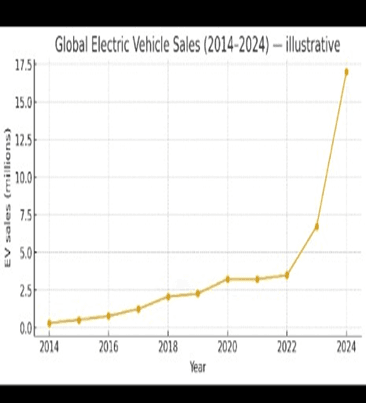
Electric vehicles are reshaping transport: cleaner tailpipes, a route to lower lifecycle emissions when charged with low-carbon electricity, and new vehicle architectures that change how cars are designed and maintained. Global EV sales and public charging infrastructure have accelerated strongly in recent years — the global market saw a substantial jump to roughly 17 million electric car sales in 2024, reflecting broad adoption.
2) Core EV components, what’s under the hood
Battery pack (the heart)
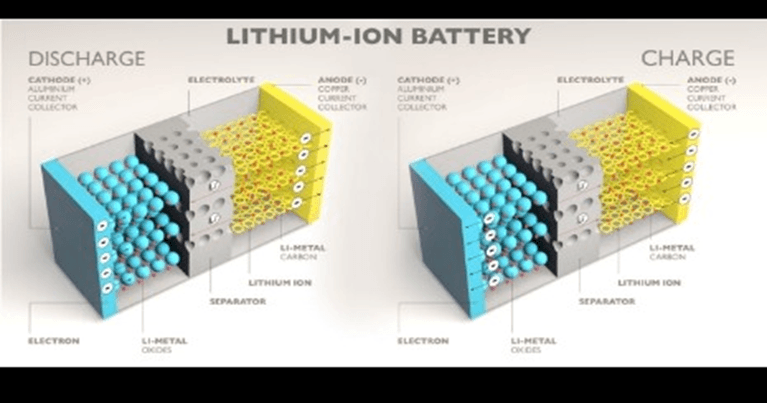
- Cells → modules → pack. Individual cells are grouped into modules and modules into packs. Packs include a Battery Management System (BMS) and thermal management (cooling/heating).
- Chemistries: NMC (nickel manganese cobalt), NCA (nickel cobalt aluminium), and LFP (lithium iron phosphate) are common. LFP is cheaper and safer (longer cycle life) but has slightly lower energy density.
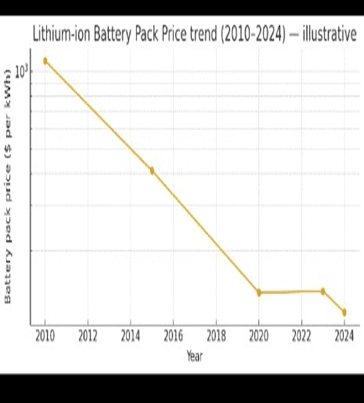
- Cost trend: battery pack costs have fallen dramatically (BNEF reported pack prices dropping to about $115/kWh in 2024), which is a major reason EVs are becoming cost-competitive.
Electric motor(s)
- Most EVs use one or more AC motors (permanent magnet synchronous motors or induction motors). They are compact, highly efficient, and provide high torque at low speed.

Power electronics (inverter / DC–DC / onboard charger)
- Inverters convert DC battery power into AC for the motor and control speed/torque.
- Onboard chargers convert AC grid power to DC to charge the battery and manage charging rates and safety.
Thermal & battery management
- Maintains battery temperature for performance and longevity (liquid cooling/heating, air cooling in simpler systems). BMS monitors cell voltages, currents, and temps; it balances cells and protects from over/under voltage.
Charging hardware
- AC charging (Level 1/2): slower, suitable for home/workplace.
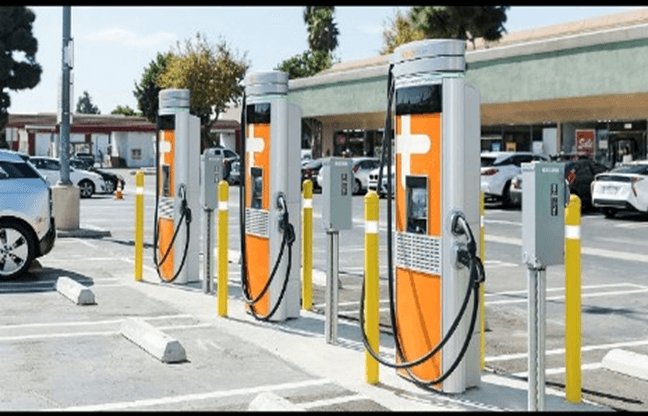
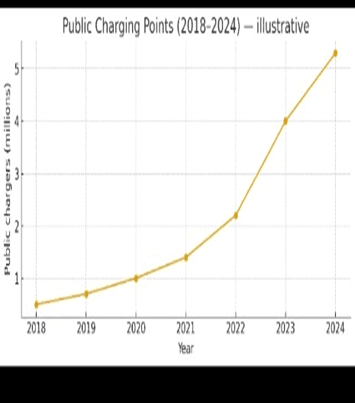
- DC fast charging (Level 3): rapid top-ups at public stations (power levels vary: 50 kW → 350+ kW). Expansion of public DC infrastructure is critical to public adoption. IEA reports >1.3 million public charging points were added in 2024 alone.
3) Performance & range — what’s realistic
Median range for new EVs has increased substantially; for model-year 2024 the median all-electric range reached ~283 miles (EPA median), reflecting improvements in cell energy density and vehicle efficiency
4) Economics: why costs fell
- ies of scale, improved chemistries and manufacturing, and wider adoption of LFP for some segments) is the main driver. Lower battery $/kWh pushes down vehicle manufacturing cost and total cost of ownership. BNEF documents the big year-on-year drop to ~$115/kWh in 2024.
5) Infrastructure & charging behavior
- Public charging infrastructure expanded rapidly — millions of new public chargers added in recent years, but distribution remains uneven (dense in urban/wealthy markets, sparse in rural/low-income regions). IEA projects much higher growth is needed to meet future demand.
- Home charging is dominant for daily use; public DC fast charging supports long trips and Fleets
6) Grid & systems integration
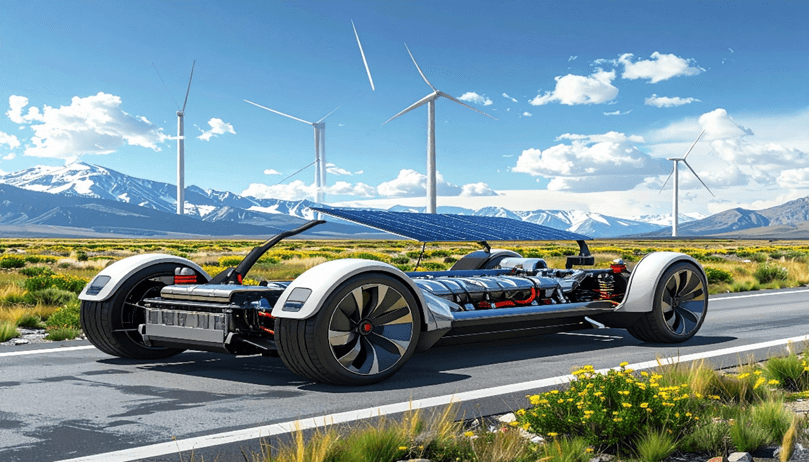
- EV uptake interacts with electricity grids — smart charging, time-of-use rates, vehicle-to-grid (V2G) and managed charging help flatten demand peaks and integrate renewables. Utilities and policymakers are developing incentives and standards to manage load and upgrade distribution infrastructure.
7) Technical challenges & engineering opportunities
- Battery lifetime & degradation: cell chemistry, thermal management, and BMS strategies are active R&D areas.
- Raw material supply (lithium, nickel, cobalt): supply chain scaling, recycling, and lower-use chemistries (LFP / cobalt-reduced cathodes) help mitigate risk.
- Charging speed vs battery longevity: ultra-fast charging stresses cells; thermal management and fast-charging-optimized chemistries are needed.
- Standardization & interoperability: connector types (e.g., CCS, CHAdeMO, GB/T) and roaming/payment APIs still require work globally.
8) What’s next? (trends to watch)
- Greater adoption of LFP for mass-market models; niche/long-range models keep high-Ni chemistries.
- Improved recycling infrastructure and second-life applications for retired EV packs.
- Continued battery cost declines and energy density improvements.

9) Charts & image
I generated three illustrative charts to accompany this blog (numbers are aligned with the cited reports but plotted as an illustrative series for clarity):
- Global EV sales (2014–2024) — EV sales chart
- Battery pack price trend (2010–2024) —Battery price chart
- Public charging points (2018–2024) — Public chargers chart


10) Sources (key, authoritative)
- IEA — Global EV Outlook / Trends in electric car markets (Global sales & charging infrastructure).
- BloombergNEF (BNEF) — battery pack price data and analysis.
- U.S. Department of Energy / EPA — median EV range statistics for model years.
- Industry summaries / market writeups (Virta, etc.) for fleet & market sizing context.
Energyassetspro is providing technical and useful information and guidelines …keep it up